Shopping cart
You have no items in your shopping cart.

By Castle Furniture · Updated August 9, 2026
The best wardrobe door style depends on your room size, layout, and lifestyle: sliding doors save space and suit modern, minimalist rooms, while hinged doors offer full access and a classic, luxurious feel. For Houston homes, consider humidity, customization, and long-term durability to make a choice that lasts decades. What follows is a detailed examination of every factor that separates a wardrobe you’ll love from one you’ll tolerate—materials, mechanisms, safety, and the quiet daily experience of living with your choice.
Key Takeaways
The material you choose for wardrobe doors directly dictates the room’s entire visual weight, how light moves through the space, and what kind of daily maintenance you’re signing up for. Wood, glass, and mirror are not interchangeable aesthetics—they solve different spatial problems.
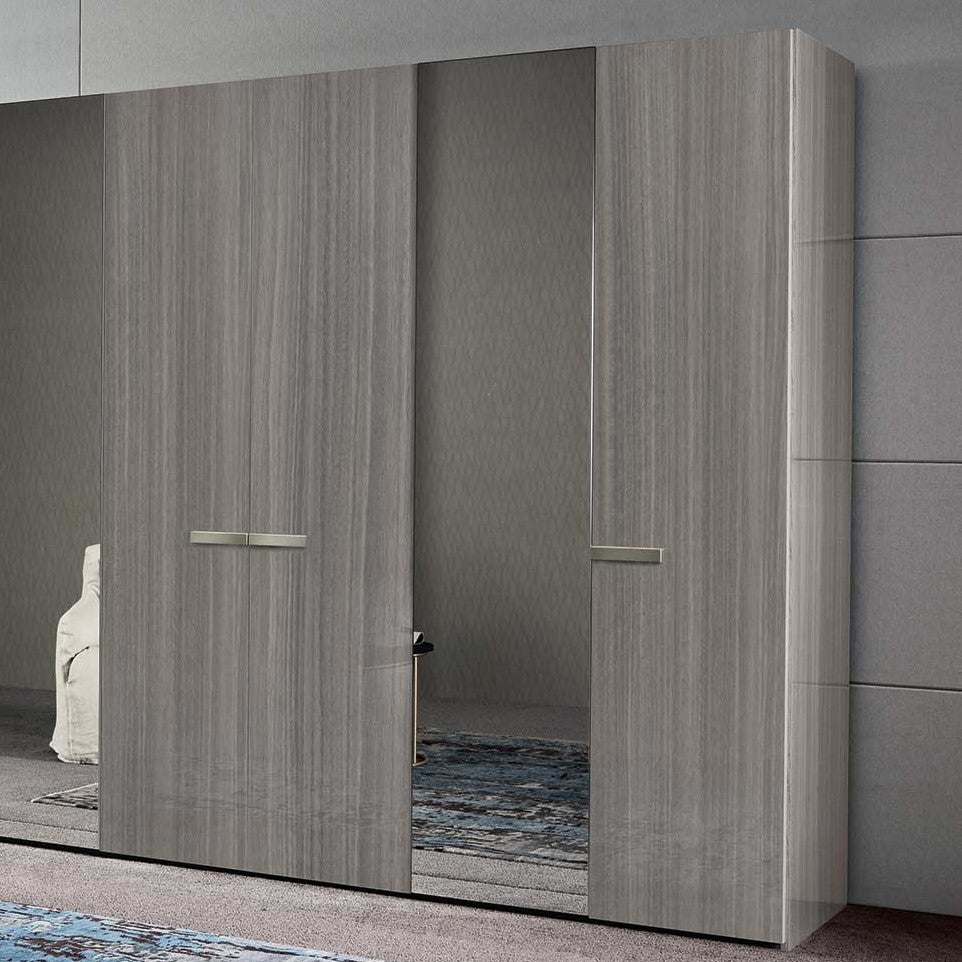
Wood veneers—walnut, oak, Kotò, Termocotto Oak, and eucalyptus—are the foundation of most wardrobes we hand-select from Italian and Spanish workshops. A high-gloss lacquered walnut door, like what you see on the Alf Italia Iris wardrobe with its Eucaly Gray Eco Veneer finish, reflects just enough light to keep a Houston bedroom from feeling heavy, while the grain still reads as warm and substantial. Solid wood and thick veneers resist the subtle warping that cheaper engineered cores suffer from in our humidity. They are the heaviest option, which matters if you’re considering a hinged door that swings out into the room. You need clearance, and you need hinges rated for that weight over decades of use.
Glass doors—typically frosted, reeded, or clear with an aluminum frame—are what we specify when a client tells us the room feels closed in. They borrow light from windows and let you display a curated interior without exposing every folded sweater. The trade-off is acoustic: glass transmits more sound than a solid wood panel. If this wardrobe sits in a master bedroom where one person rises at 5:00 a.m., a full wood door will hush the opening and closing far more effectively.
Mirror finishes are the most architecturally assertive choice. A full-height mirrored sliding door doubles the perceived square footage of a narrow Houston primary suite and eliminates the need for a separate standing mirror, freeing up floor space. The Giorgio Collection two-door armoire demonstrates how a mirrored panel, when framed by a high-end lacquer structure, reads as a deliberate design element rather than a gym wall. The practical reality is that mirror doors show every fingerprint and require a streak-free cleaning discipline, especially in homes with young children. Wood hides daily dust and smudges far more forgivingly.
For sliding systems, the door material directly affects track stress. A heavy solid-wood slab demands a precision-engineered track and roller mechanism—something the Italian manufacturers we work with, like ALF Italia and Arredo Classic, engineer specifically for their panel weights. A lighter glass or mirror panel puts less downward force on the track, which can extend the life of the rolling hardware in a humid climate where metal components are already working against ambient moisture. The decision ultimately hinges on whether you prioritize light and spatial illusion, or acoustic privacy and tactile warmth.
A wardrobe from our family-run showroom is never just a box for clothes. It is a highly personal system, configured to the precise way you live. Because our collections are sourced directly from family-owned workshops in Italy, Spain, and Turkey, the customization runs far deeper than choosing between two stock finishes.
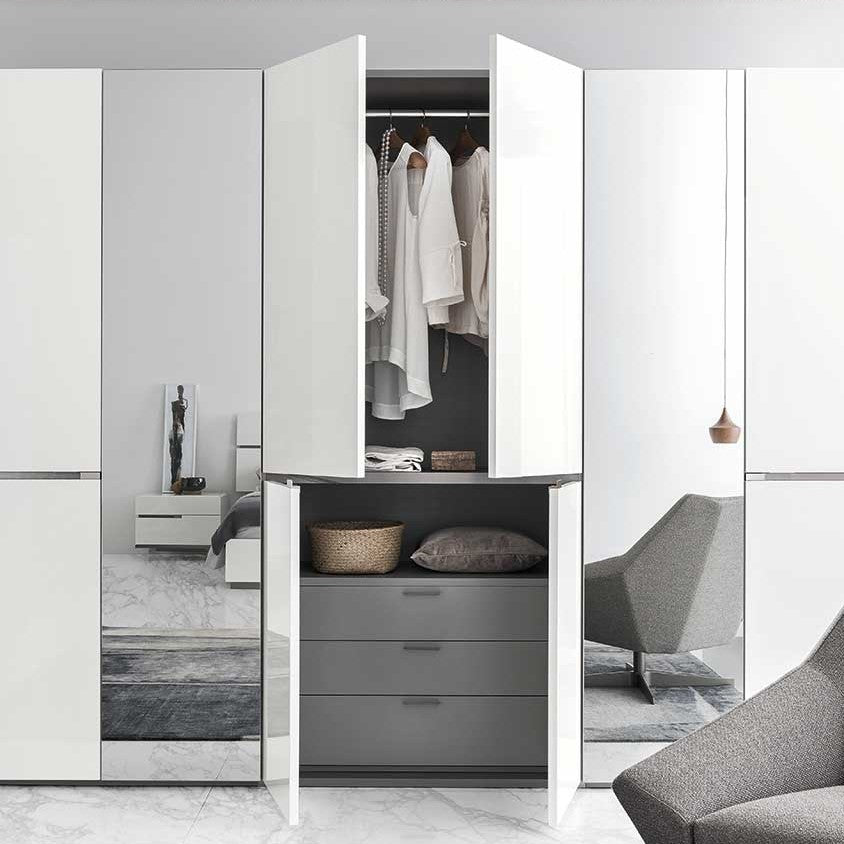
Start with the interior illumination. Integrated LED lighting is a functional luxury that transforms a deep cabinet from a dark cavern into a gallery for your garments. We can specify motion-activated hanging rods that light up the moment you reach inside, or recessed shelf lighting that eliminates shadows in a walk-in configuration. This is not an aftermarket strip. It is a hardwired, engineered component of pieces from makers like Alf Italia, where the electrical is chased into the cabinetry during production, leaving clean lines and zero visible clutter.
The daily experience of quality lives in the soft-close mechanisms. A door that glides shut without a sound, or a drawer that retracts with a gentle, dampened pull, signals genuine craftsmanship. We specify integrated soft-close on both hinged doors and internal drawers, eliminating the jarring thud that cheapens a bedroom’s atmosphere. This hardware is built for decades of silent use.
The true separation from big-box inventory lies in the integrated organizers. We configure the interior to your specific wardrobe, not a generic template. That means specifying a precise mix of hanging rods at double-height for long dresses, felt-lined valet rods for selecting tomorrow’s suit, cedar-lined drawers for knitwear, angled shelving for shoes, and discreet compartments for jewelry. For a Houston homeowner who wants a space that feels uniquely theirs, we can design a layout where every belt, tie, and handbag has a dedicated, hand-selected place. This level of bespoke interior planning—available on everything from a two-door armoire by Giorgio Collection to a sprawling five-door configuration—ensures you own a piece of furniture that fits your life exactly.
The true cost of a wardrobe isn’t the price tag on the showroom floor—it’s what you spend, or don’t spend, keeping it functional and beautiful a decade later. Over a 10-year span, a hinged wardrobe from a hand-selected European collection will almost always cost less to own than a sliding-door system, and the reason comes down to mechanical simplicity.
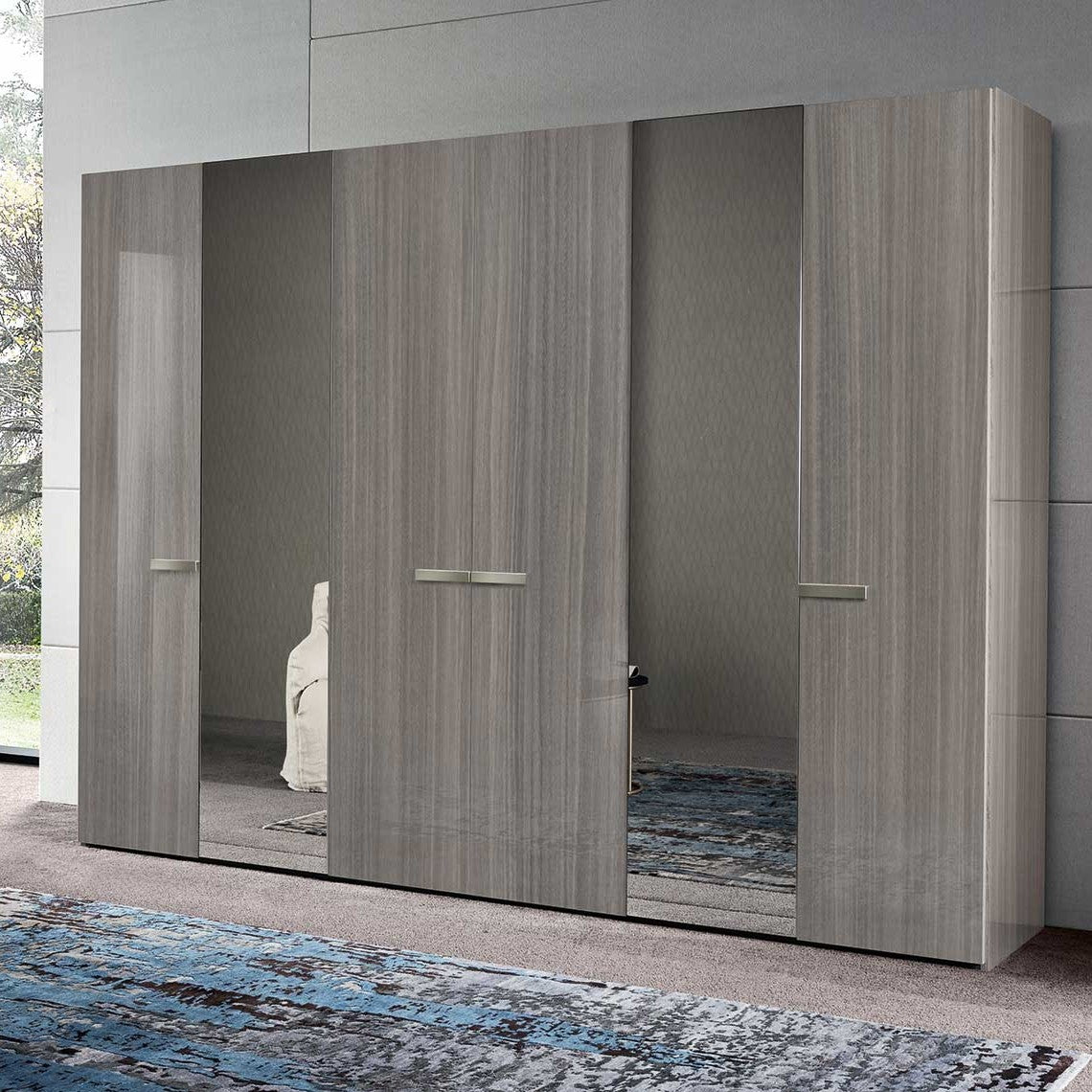
A hinged door relies on two or three high-quality butt hinges—solid brass or stainless steel on the pieces we source from Italy and Spain. These have no rollers, no tracks, no tension cables. They don’t degrade in any meaningful way under normal residential use. The only service a hinged door might ever need is a minor screw tightening if a door settles, a five-minute fix that requires no replacement parts.
Sliding doors are fundamentally different. They ride on a track and glide on rollers or bearings that wear down with every open and close. In Houston’s climate, where fine airborne dust and humidity are constants, track fouling accelerates that wear. Within five to seven years, you’ll likely replace rollers or bearing carriages. By year ten, a track itself can develop a subtle warp or groove that makes the doors stick or rattle—at which point you’re replacing the entire track assembly, not just the rollers. Those parts are proprietary to the manufacturer. If you bought from a mass-market retailer, you may find the line discontinued and parts unavailable, turning a small repair into a full wardrobe replacement. With our family-run showroom, we maintain direct relationships with the European workshops—Alf Italia, Arredo Classic, Giorgio Collection—and we support clients with parts sourcing years after delivery. That continuity eliminates the biggest hidden cost of sliding systems: orphaned hardware.
Soft-close mechanisms add a minor service point. On a hinged door, the soft-close damper is a small piston housed in the hinge cup; it’s replaceable in minutes if it ever fails, though failures are rare on the Italian hardware we specify. On a sliding door, the soft-close is a more complex catch-and-damper mechanism that lives inside the track profile—harder to access, harder to source, and more likely to need attention because it works against the door’s full weight on every cycle. Over 10 years, a hinged wardrobe with soft-close might need zero interventions. A sliding equivalent might need two or three. When you factor in the white-glove delivery and setup we provide—ensuring every door is perfectly aligned from day one—the long-term ownership math tilts decisively toward the hinged design. You’re choosing a decade of quiet reliability over a decade of incremental nuisance.
A fitted wardrobe directly raises a room’s perceived value, but the mechanism matters less than the quality of the piece itself. What Houston appraisers and discerning buyers actually notice is permanence, material integrity, and how seamlessly the storage integrates into the architecture of the room.
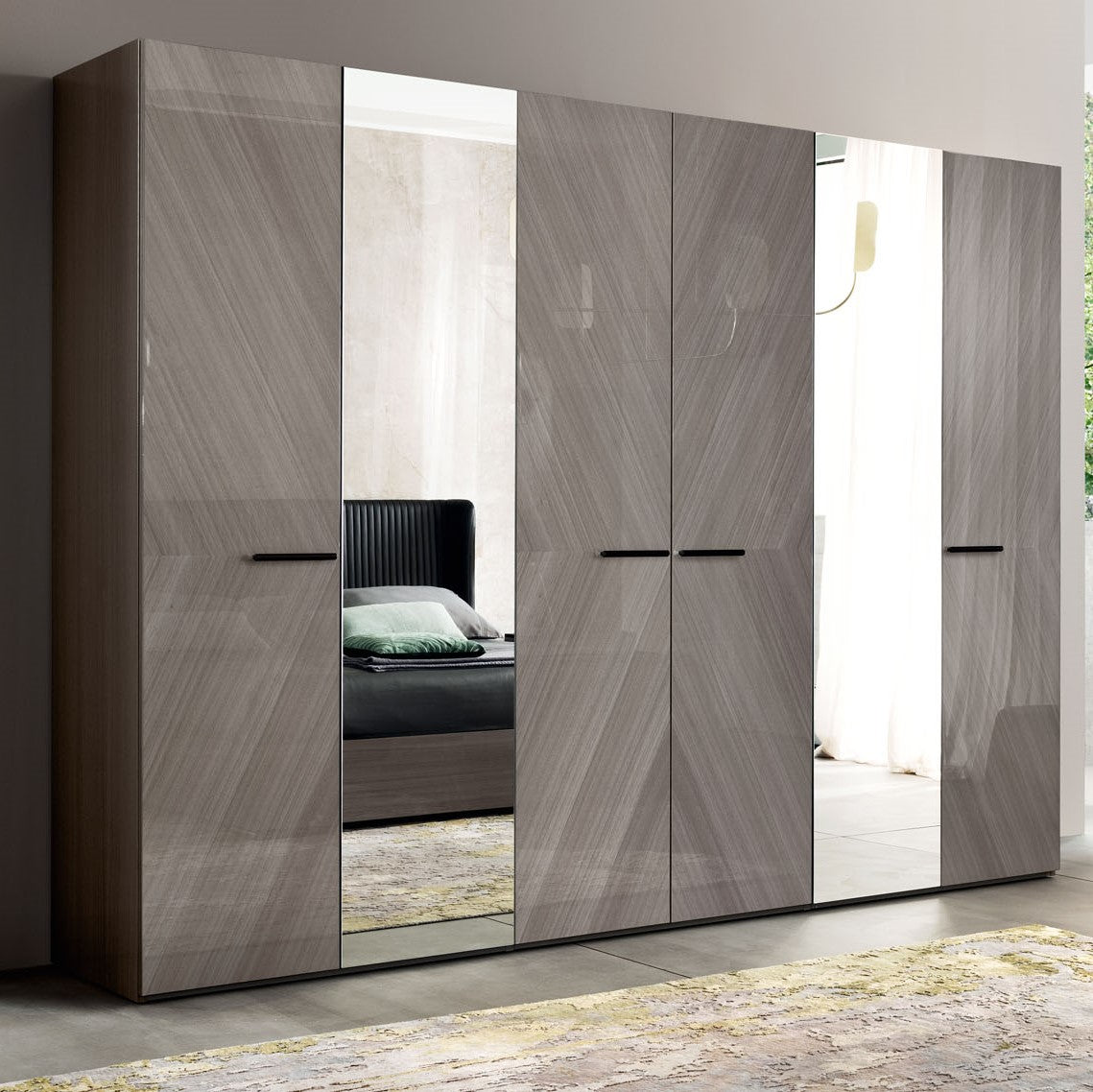
A hinged wardrobe from a recognized Italian or Spanish maker—solid wood veneers, soft-close hinges, a high-gloss lacquer that still looks flawless after a decade—reads as built-in millwork. That perception translates to real dollars. A sliding-door wardrobe can achieve the same effect, provided the track system is substantial and the doors glide without wobble. A lightweight, mass-produced sliding unit often signals a temporary fix rather than an heirloom addition. Buyers touring a home in River Oaks or The Woodlands will open a door and test the weight of a drawer; they will register the difference between a hand-selected European piece and a flat-pack placeholder.
For a formal appraisal, freestanding furniture rarely appears as a line item on the valuation report. However, a primary bedroom suite furnished with a cohesive, high-end wardrobe—particularly a 3-door or 4-door configuration from a collection like Alf Italia’s Iris or Arredo Classic’s Melodia line, both carried in our family-run showroom—elevates the entire room’s presentation. It signals to the appraiser that the home has been maintained to a standard of lasting craftsmanship, not staged for a quick sale. This matters in Houston’s luxury market, where established homeowners aged 35–65 often compete for buyers who expect a design-center experience the moment they walk through the door. The wardrobe becomes part of the room’s story: a stunning, solid and well-made focal point that suggests the rest of the property has been cared for with the same attention. When you choose a piece that is genuinely unique—sourced directly from Italy, Spain, or Turkey rather than a generic catalog—you are making a quiet, long-term statement about the home’s value.
Hinged wardrobe doors are the quieter choice, full stop. They swing on fixed side-mounted hinges that, when properly aligned and installed, produce almost no sound beyond the soft, solid contact of the door meeting the frame. In a master bedroom, where a sleeping partner’s uninterrupted rest is the priority, this near-silent operation is a defining advantage. The only potential for noise comes from the latch or handle mechanism, and even that is negligible on a well-made piece.
Sliding doors, by contrast, ride along a track system that inherently generates more sound. The rollers—whether nylon or ball-bearing—create a low-grade rumble or whisper as they travel, a sound that becomes noticeably intrusive in the quiet of a bedroom at 2 a.m. This isn’t a defect; it’s the mechanical reality of a door whose weight is suspended and in motion.
The setting changes the stakes. In a living area or a dining room where ambient conversation, music, or kitchen activity already fills the space, the soft mechanical hum of a sliding wardrobe door fades into the background and rarely registers. It’s a non-issue. But in a bedroom, that same sound has no competition. The track itself also matters: aluminum tracks with high-quality, sealed bearing rollers run more quietly than basic steel tracks, and top-hung systems that don’t collect debris in a floor channel stay smooth and hushed over time. When you walk through the room vignettes at our family-run showroom on Fondren Road, you can test this directly—open a hinged Alf Italia wardrobe and then slide a panel on a different configuration. The difference is immediate and physical. For a Houston homeowner designing a serene, personal bedroom retreat, that quietness is a detail that feels solid and well-made every single morning.
Sliding wardrobe doors are the inherently safer choice for households with young children. The operating mechanism itself largely eliminates the primary hazard found on hinged doors: the heavy, closing-edge pinch point. A hinged door creates a powerful scissor-action between the door and the frame, directly at a toddler’s finger and hand height. The danger isn't theoretical; a child’s instinct to wrap their hand around a moving door’s edge can result in crushed fingertips or worse. Sliding doors glide along a track with their leading edge moving parallel to the stationary panel, leaving no accessible gap for small fingers to be trapped during normal operation. The potential pinch point shifts to where the doors overlap, but this gap is typically inaccessible to a child’s grip when the door is in motion.
This isn't to say hinged wardrobes must be ruled out. The critical safety feature to demand is a soft-close mechanism, a specification standard on the European-imported collections we hand-select from Italy and Spain. These dampeners catch the door in the last few inches of its swing, decelerating it to a silent, powerless close regardless of how hard it was pushed. This effectively neutralizes the momentum that causes injury. For sliding systems, the focus should be on a high-quality, bottom-guided track. Inferior systems can allow a child to derail a door, creating a tip-over risk, whereas the precision-engineered hardware on the Arredo Classic and Alf Italia wardrobes in our showroom ensures the panel stays securely seated. You can verify this stability yourself—run a door back and forth to feel the weighted, deliberate glide of a solid and well-made mechanism. Choosing a sliding door provides a passive safety advantage that doesn't rely on a mechanical add-on, while a soft-close hinged door makes the risk manageable with a feature you can test in person before any decision.
For a Houston home, the choice between hinged and sliding wardrobes is fundamentally a decision about which climate vulnerability you can better control. Hinged doors, particularly those crafted from solid wood or wood veneers like the walnut, oak, and Kotò finishes we hand-select from Italian and Spanish artisans, respond to humidity by expanding and contracting across their entire vertical plane. A door that fits perfectly during a dry January may stick against the frame during a humid August, not because of a defect, but because the wood has absorbed moisture from the air and swollen. This is a reversible, seasonal behavior inherent to natural materials, and it is managed through precise initial installation and, in some cases, the slight adjustment of hinges. The integrity of the door itself remains intact; the movement is predictable and correctable.
Sliding doors introduce a different, less forgiving failure point: the track. When a room’s humidity fluctuates, the floor or the base platform beneath a sliding system can shift almost imperceptibly. A track that is even a millimeter out of alignment will cause the doors to drag, bind, or jump their rollers. Worse, in a climate like Houston’s, where sustained humidity is a constant, a warped track is not a seasonal inconvenience—it is a permanent mechanical failure. The rollers wear unevenly, the soft-close mechanisms lose their precision, and the entire system degrades. You are no longer dealing with the natural, manageable character of wood; you are dealing with a broken mechanism. Our family-run showroom guides clients toward hinged wardrobes with high-gloss lacquer or eco-stone finishes not to avoid the climate, but to work with it, selecting materials whose beauty deepens with age rather than components that fight against it.
For elderly or disabled users, sliding wardrobes are almost always the superior choice, and the difference comes down to a single, non-negotiable factor: the clear floor space required to operate the doors. A hinged wardrobe door, even on a compact 2-door armoire like the Giorgio Collection model in our showroom, demands a sweeping arc of clearance—typically 24 to 30 inches of unobstructed flooring directly in front of the piece. For someone using a walker, a wheelchair, or simply managing unsteady balance, that arc becomes an obstacle that must be navigated twice for every single access. It forces a backward maneuver in a space that may already be tight, creating a genuine fall risk. Sliding doors eliminate that hazard entirely. They glide parallel to the wardrobe body, demanding zero encroachment into the room’s walking path. A person can roll directly up to the face of a 3-door sliding wardrobe and access every compartment from a seated or standing position without ever needing to step back or reposition a mobility aid.
The physical effort to operate the doors is another critical distinction. Hinged doors require a pulling motion that engages the shoulder, arm, and often the core to control the door’s weight through its full swing, especially on a solid, well-made Italian import with substantial wood and glass. For someone with arthritis, reduced grip strength, or a limited range of motion, this can be a daily struggle. Quality sliding systems ride on tracks that, when properly engineered, allow a door to be set in motion with a light push from a finger or the side of a hand. The hardware matters immensely here, and this is where a curated, hand-selected collection proves its worth. The sliding wardrobes we source from manufacturers like Alf Italia are built with precision track and roller assemblies that resist sticking or jumping the rail, a common failure in lesser mechanisms that would render the wardrobe unusable for a person with limited strength. During a one-to-one design consultation at our Fondren Road showroom, we can walk you through the exact resistance and feel of these mechanisms, letting you test the operation yourself before making a decision. This is not a detail you can verify on a screen. The goal is a piece of fine furniture that adapts to your life for decades, not one that becomes a daily physical challenge.
Sliding wardrobes may need more maintenance due to track and roller wear, especially in humid climates. Hinged wardrobes typically have lower repair frequency over 10+ years.
Humidity can warp cheaper wood cores and stress metal track components. Solid wood and thick veneers resist warping, and precision-engineered tracks from Italian makers handle moisture better.